· 46 min read
Karp and Dimon are the CEOs who sound hawkish on China
Washington has spent two years arguing about how hard to push on China: tariffs, export controls on chips, rare-earth supply chains. The CEOs whose companies sit in the middle of that fight talk about it all the time. We took every statement about China that 35 CEOs made in interviews, podcasts and conference talks since January 2025, read each one in context, and labelled it hawkish, conciliatory or neutral.
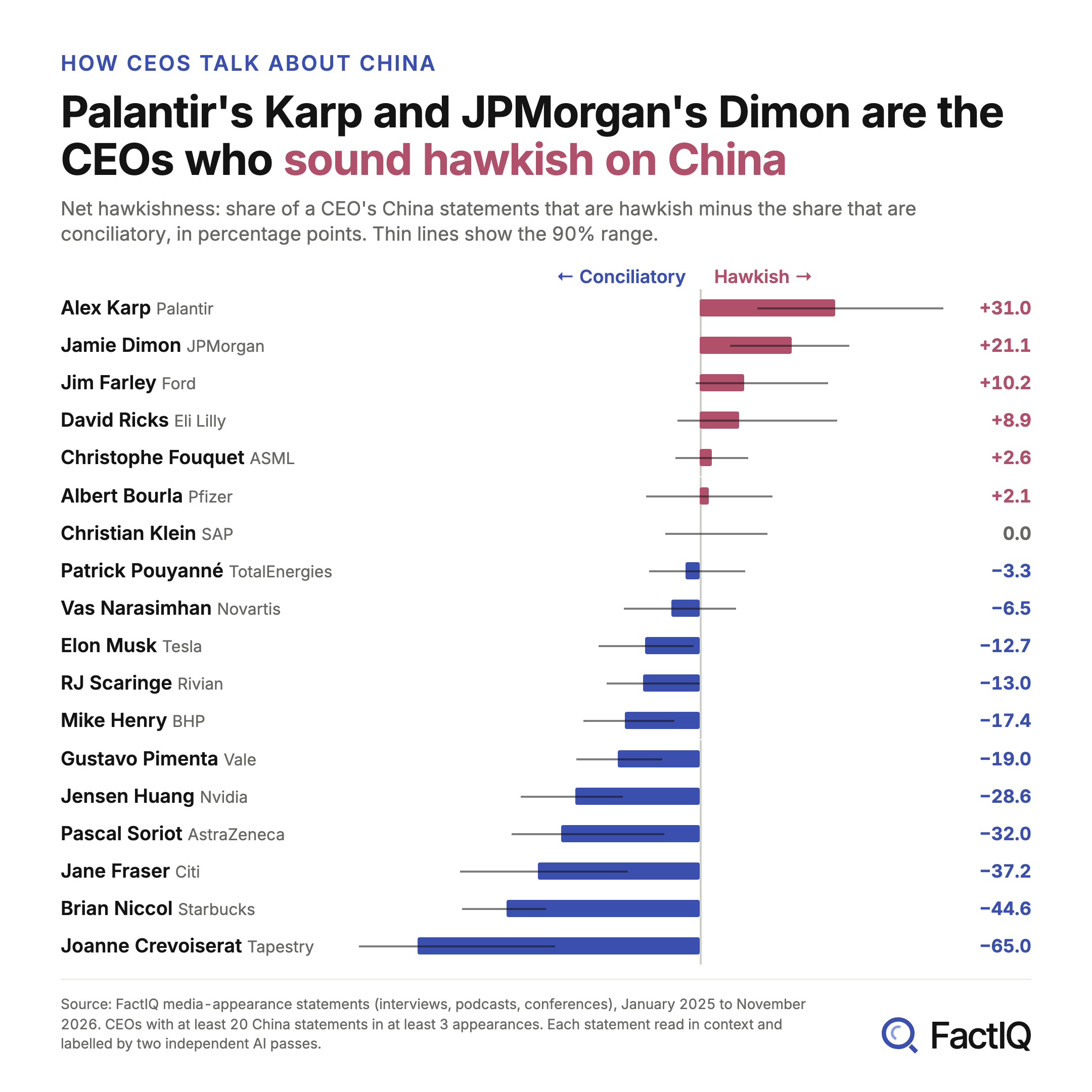
+31.0 and +21.1: Alex Karp and Jamie Dimon. They are the only two CEOs on the chart whose whole 90% range sits above zero. Most of what CEOs say about China takes no side at all: 70% of the 1,200 statements are neutral.
The hawks
Alex Karp, Palantir (+31.0). 15 of his 42 China statements are hawkish and 2 are conciliatory. Karp frames China as the other side of a two-player contest: "This is a have-have-not world. It's going to be either us or them basically deciding the world order" (April 2026).
Jamie Dimon, JPMorgan Chase (+21.1). Dimon argues for cutting supply-chain dependence: "a barrier, that we will not import rare earths from China. And we have to do it quick" (May 2026). He is not one-sided. 9 of his 95 statements are conciliatory, such as "I don't think they have to be a natural enemy of ours" (Economic Club of Chicago, October 2026).
Jim Farley, Ford (+10.2). Farley talks about China as a competitive threat: "the competitive threat from China especially really requires a complete reinvention" (Automotive News, September 2026). He also praises Chinese carmakers often, so his range (−1.0 to +29.4) reaches zero and we do not call him a hawk with confidence.
The most conciliatory
Joanne Crevoiserat, Tapestry (−65.0). 13 of her 20 statements are conciliatory and none are hawkish. "I believe that China can be our fastest growing market over the next five years" (CGTN, April 2026).
Brian Niccol, Starbucks (−44.6). "We do believe China is a tremendous growth market" (Bloomberg, January 2026).
Jane Fraser, Citi (−37.2). Fraser argues for stability: "China's a very important partner of the US from a trading point of view" (Council on Foreign Relations, June 2026).
Jensen Huang, Nvidia (−28.6). Huang has the most China statements of anyone (147). He is the loudest critic of US export controls: "I completely disagree that we should ban China of all American products" (CBS Sunday Morning, September 2026).
Elon Musk, Tesla (−12.7). Musk mostly praises Chinese manufacturing: "China just has a very strong inherent ability to do manufacturing well" (CGTN, September 2026).
The pattern: CEOs who sell to Chinese consumers or companies (Tapestry, Starbucks, Citi, Nvidia, the miners) talk about China as an opportunity. The CEOs who lean hawkish sell to the Pentagon, compete with Chinese exporters, or worry about where critical supplies come from.
Methodology
Source. FactIQ's media-appearance statements: things executives said in TV interviews, podcasts and conference talks, each stored with the speaker's exact words, the date and a timestamped link. Earnings calls are not included.
Which statements. Every statement by a company executive that mentions China (china, chinese, beijing, CCP or Xi Jinping) in an appearance published between 2025-01-09 and 2026-11-06. We kept sitting CEOs of companies based outside mainland China who had at least 15 such statements, and merged different spellings of the same name. The same quote is often recorded twice, for example when one interview is published in two places, so each quote counts once per CEO. That left 1,200 statements by 35 CEOs.
Labelling. A word list cannot tell which side a speaker is on: "export controls" is hawkish from someone who wants them and conciliatory from someone arguing against them. So each statement was read in context and given one label, hawkish, conciliatory or neutral, by an AI model (Claude Haiku) following the written rubric below. The model saw the quote, a one-line summary of it, the speaker and the appearance, in shuffled order, five statements at a time.
Two passes. Every statement that received a stance in the first pass was labelled again by a second, independent pass that could not see the first label. To keep the second pass honest, 300 statements the first pass called neutral were mixed in. A statement counts as hawkish or conciliatory only when both passes agree; otherwise it is neutral. The two passes gave the same label 82% of the time (Cohen's kappa 0.72), and in only 2 of 842 cases did one say hawkish and the other conciliatory.
Check against a blind sample. A separate, more capable model (Claude Fable) labelled a random 100 statements with the same rubric before seeing any of the Haiku labels. The final labels match that sample on 93% (kappa 0.82), with no case of hawkish against conciliatory. After the first pass alone the match was 80%: the model was too quick to read a stance into plain business facts. We tightened the rubric's definition of neutral before the second pass, which is why the second pass uses the longer rubric.
Scoring. Net hawkishness = the share of a CEO's China statements labelled hawkish minus the share labelled conciliatory, in percentage points. Neutral statements count in the denominator, so a CEO who mostly reports sales figures scores near zero.
Uncertainty. The 90% range comes from resampling each CEO's appearances 4,000 times. We resample whole appearances, not single statements, because ten statements from one interview are not ten independent observations.
What is on the chart. The 18 CEOs with at least 20 China statements across at least 3 appearances. The table below has all 35.
Limits. No human coded these statements. The labels come from one AI model and the blind check from another, so the two can share blind spots. About 7 in 100 labels would be disputed. Most CEOs have few statements with a stance (356 of 1,200 overall), so the ranges are wide and neighbours on the chart should not be ranked against each other. A statement is judged on its own; an interview's overall argument can differ. Coverage depends on which appearances FactIQ has recorded.
The rubric
# Labelling rubric: a CEO's stance toward China

Each item is one statement made by a company CEO in an interview, podcast or conference talk.
`quote` is what they said. `summary` restates it in context. Label the stance toward China that
THE SPEAKER expresses in that statement. "China" means the Chinese government, the Chinese
economy or market, or Chinese companies.

Give each statement exactly one label:

**hawkish** - the speaker treats China as an adversary, a threat, or a rival that has to be
countered or beaten. Includes:
- warning that China (or Chinese companies) is a danger to their country, industry or company;
- saying dependence on China is a risk that must be reduced (reshoring, decoupling, new supply chains);
- supporting or calling for tariffs, export controls, bans or other restrictions aimed at China;
- accusing China of unfair conduct (theft, subsidies, dumping, coercion, spying);
- "we must win the race against China" framing.

**conciliatory** - the speaker treats China as a partner, an opportunity, or a relationship worth
keeping. Includes:
- describing China as an attractive or important market, customer base or source of talent,
  with commitment to being there;
- calling for engagement, dialogue, cooperation, stability or trust between the countries;
- arguing AGAINST tariffs, export controls, decoupling or other restrictions on China;
- praising China, Chinese companies or Chinese partners without presenting them as a threat.

**neutral** - no stance toward China. Includes:
- plain business reporting: sales, volumes, prices, market share, forecasts, operations in China;
- describing a policy, an event or someone else's position without endorsing or opposing it;
- factual statements about what China or Chinese companies do or have, with no judgment;
- China is mentioned only in passing, or the statement is not really about China.

## Rules

1. Judge the meaning in context, never single words. "Export controls" is hawkish when the
   speaker supports them, conciliatory when the speaker argues against them, and neutral when
   the speaker only describes their effect on the business.
2. Label the speaker's own view. If they report what a government or a competitor thinks
   without agreeing or disagreeing, that is neutral.
3. Describing strong Chinese competition is hawkish only if it is framed as a threat or
   something that must be countered. Admiring it, or stating it as fact, is conciliatory or neutral.
4. Saying sales in China fell or rose is neutral. Saying China is a great market the company
   is committed to is conciliatory.
5. When a statement really carries no stance, or you cannot tell, choose neutral. Do not force a stance.

## Statements that are neutral, even though they mention China

Most statements carry no stance. These are all neutral:
- Reporting numbers or facts about the business in China: units sold, revenue, number of sites,
  stores, partners or customers, an investment amount, how long the company has been there.
  (It becomes conciliatory only when the speaker adds an explicit judgment such as "investing in
  China is the right decision" or "China is a very important market for us".)
- Comparing China with the US or other countries on size, speed, cost, energy or output,
  without saying what should be done about it.
- Saying a company or industry has to "compete with China" as a plain fact of business,
  without calling China a threat or calling for action against it.
- Describing what customers, governments or other companies are doing about China
  (for example moving supply chains) without endorsing or opposing it.
- Listing China as one item among several risks, markets or countries.
- Forecasts about what China or Chinese companies will do next, stated without alarm or approval.
Query
SELECT c.claim_id, c.speaker, c.primary_ticker, c.canonical_statement, c.verbatim_quote,
       c.start_s, a.video_id, a.url, a.title, a.channel, a.published_at
FROM transcripts.appearance_claims c
JOIN transcripts.appearances a USING (video_id)
WHERE c.speaker_role = 'exec'
  AND c.primary_ticker IS NOT NULL AND c.primary_ticker <> ''
  AND a.published_at >= DATE '2025-01-01'
  AND c.search_tsv @@ to_tsquery('english', 'china | chines | beij | ccp | xi<->jinp');
Scoring
# labels: one row per statement, with the stance from each of the two passes
def final_stance(first_pass, second_pass):
    # a statement gets a stance only when both passes give it the same one
    if first_pass != "neutral" and first_pass == second_pass:
        return first_pass
    return "neutral"

def net_hawkishness(statements):
    hawkish = sum(s["stance"] == "hawkish" for s in statements)
    conciliatory = sum(s["stance"] == "conciliatory" for s in statements)
    return 100 * (hawkish - conciliatory) / len(statements)

def interval(statements, draws=4000):
    # resample whole appearances, because statements from one interview move together
    by_appearance = group_by(statements, key="video_id")
    scores = sorted(
        net_hawkishness(flatten(random.choices(by_appearance, k=len(by_appearance))))
        for _ in range(draws)
    )
    return scores[int(0.05 * draws)], scores[int(0.95 * draws)]
Scores for all 35 CEOs
| CEO | Company | Statements | Appearances | Hawkish | Conciliatory | Neutral | Net hawkishness | 90% range | On chart |
|---|---|---|---|---|---|---|---|---|---|
| Joaquin Duato | Johnson & Johnson | 9 | 3 | 3 | 0 | 6 | +33.3 | +9.1 to +71.4 | No: too few statements or appearances |
| Alex Karp | Palantir | 42 | 12 | 15 | 2 | 25 | +31.0 | +13.2 to +56.1 | Yes |
| Jamie Dimon | JPMorgan Chase | 95 | 20 | 29 | 9 | 57 | +21.1 | +7.0 to +34.3 | Yes |
| Jim Farley | Ford | 88 | 16 | 20 | 11 | 57 | +10.2 | −1.0 to +29.4 | Yes |
| Mike Wirth | Chevron | 10 | 5 | 1 | 0 | 9 | +10.0 | 0.0 to +27.3 | No: too few statements or appearances |
| David Ricks | Eli Lilly | 45 | 9 | 7 | 3 | 35 | +8.9 | −5.1 to +31.6 | Yes |
| Jeremy Allaire | Circle | 12 | 5 | 1 | 0 | 11 | +8.3 | 0.0 to +40.0 | No: too few statements or appearances |
| Bill Oplinger | Alcoa | 13 | 3 | 1 | 0 | 12 | +7.7 | 0.0 to +9.5 | No: too few statements or appearances |
| Kent Masters | Albemarle | 18 | 2 | 2 | 1 | 15 | +5.6 | −16.7 to +16.7 | No: too few statements or appearances |
| Christophe Fouquet | ASML | 39 | 12 | 2 | 1 | 36 | +2.6 | −5.7 to +11.1 | Yes |
| Albert Bourla | Pfizer | 48 | 4 | 12 | 11 | 25 | +2.1 | −12.5 to +16.7 | Yes |
| Brian Armstrong | Coinbase | 13 | 7 | 2 | 2 | 9 | 0.0 | −38.5 to +25.0 | No: too few statements or appearances |
| Mary Barra | General Motors | 18 | 5 | 2 | 2 | 14 | 0.0 | −18.5 to +28.6 | No: too few statements or appearances |
| Christian Klein | SAP | 23 | 6 | 1 | 1 | 21 | 0.0 | −8.0 to +15.4 | Yes |
| Greg Foran | Kroger | 17 | 1 | 0 | 0 | 17 | 0.0 | 0.0 to 0.0 | No: too few statements or appearances |
| Patrick Pouyanné | TotalEnergies | 30 | 12 | 1 | 2 | 27 | −3.3 | −11.8 to +10.5 | Yes |
| Vas Narasimhan | Novartis | 31 | 6 | 2 | 4 | 25 | −6.5 | −17.6 to +8.3 | Yes |
| Carol Tomé | UPS | 14 | 6 | 0 | 1 | 13 | −7.1 | −27.3 to 0.0 | No: too few statements or appearances |
| Benedetto Vigna | Ferrari | 17 | 5 | 0 | 2 | 15 | −11.8 | −26.1 to 0.0 | No: too few statements or appearances |
| Elon Musk | Tesla | 79 | 17 | 5 | 15 | 59 | −12.7 | −23.4 to −1.4 | Yes |
| RJ Scaringe | Rivian | 23 | 4 | 1 | 4 | 18 | −13.0 | −21.4 to 0.0 | Yes |
| Bill Winters | Standard Chartered | 15 | 1 | 0 | 2 | 13 | −13.3 | −13.3 to −13.3 | No: too few statements or appearances |
| Antonio Filosa | Stellantis | 14 | 4 | 1 | 3 | 10 | −14.3 | −33.3 to +16.7 | No: too few statements or appearances |
| Mike Henry | BHP | 23 | 8 | 0 | 4 | 19 | −17.4 | −26.9 to −5.9 | Yes |
| Gustavo Pimenta | Vale | 58 | 11 | 0 | 11 | 47 | −19.0 | −28.4 to −8.6 | Yes |
| Jon Moeller | Procter & Gamble | 14 | 2 | 0 | 3 | 11 | −21.4 | −28.6 to −14.3 | No: too few statements or appearances |
| Cristiano Amon | Qualcomm | 17 | 8 | 0 | 4 | 13 | −23.5 | −40.0 to −7.1 | No: too few statements or appearances |
| Dara Khosrowshahi | Uber | 16 | 9 | 1 | 5 | 10 | −25.0 | −61.5 to +6.7 | No: too few statements or appearances |
| Jensen Huang | Nvidia | 147 | 16 | 4 | 46 | 97 | −28.6 | −41.3 to −17.8 | Yes |
| Pascal Soriot | AstraZeneca | 50 | 6 | 3 | 19 | 28 | −32.0 | −43.3 to −8.3 | Yes |
| David Solomon | Goldman Sachs | 15 | 6 | 0 | 5 | 10 | −33.3 | −47.1 to −20.0 | No: too few statements or appearances |
| Jane Fraser | Citi | 43 | 7 | 0 | 16 | 27 | −37.2 | −55.3 to −16.7 | Yes |
| Brian Niccol | Starbucks | 56 | 14 | 0 | 25 | 31 | −44.6 | −54.7 to −35.4 | Yes |
| Ola Källenius | Mercedes-Benz | 28 | 1 | 0 | 13 | 15 | −46.4 | −46.4 to −46.4 | No: too few statements or appearances |
| Joanne Crevoiserat | Tapestry | 20 | 3 | 0 | 13 | 7 | −65.0 | −78.6 to −33.3 | Yes |
Raw data: what they said
Every one of the 1,200 statements, with the exact quote, the date, a timestamped link to the source, the label from each pass and the reason given, is in this CSV file. The table below shows the two most recent hawkish and the two most recent conciliatory statements for each CEO on the chart.
| CEO | Date | Label | What they said | Source |
|---|---|---|---|---|
| Alex Karp (Palantir) | 2026-10-23 | Hawkish | But currently the battle space is us or China and us being ahead is elliptical because it's like six months and we we are very different on what we do well, but like the Chinese ability to refactor their models to deal with less compute and to undercut pricing and their distillation practices, like this this their ability to do these things and the just general aptitude is not going to disappear. | Palantir |
| Alex Karp (Palantir) | 2026-07-13 | Hawkish | The disadvantage they have is one, people like you and me and the people that Europe could recruit really don't want to live in a country where they have no democratic rights or economic rights. | MDMEETS - Essential Talks with Mathias Döpfner and 2 more |
| Alex Karp (Palantir) | 2026-10-23 | Conciliatory | It's not like we're the only creative people here. Like if you see what they've done with their models, that's creative. And that's actually one of the things I've been most impressed about the Chinese reaction is that it the caricature of them again I think if people look at China I mean turns out I have a diff I like I'm obviously on our side completely, but I have a 13-14 year history of becoming a very… | Palantir |
| Alex Karp (Palantir) | 2026-07-13 | Conciliatory | We are going to get the best people in the world to come. We are going to call the best people in the world to say, "What would stop you from coming?" By the way, I told I haven't told this to this Chancellor, but I've literally told directly or indirectly to every Chancellor and every important politician that you can think of for the last 10-15 years. You got to do what Israel does, what China does, what America… | MDMEETS - Essential Talks with Mathias Döpfner and 2 more |
| Jamie Dimon (JPMorgan Chase) | 2026-10-15 | Hawkish | So as long as China's aiding and abetting something, it's going to be a tough time our relationship. | The Economic Club of Chicago |
| Jamie Dimon (JPMorgan Chase) | 2026-10-15 | Hawkish | You will be negotiating side-by-side deals with China and Russia and they won't like it. | The Economic Club of Chicago |
| Jamie Dimon (JPMorgan Chase) | 2026-10-15 | Conciliatory | And this one we have a common interest with China because I think China realized this isn't about us versus China. | The Economic Club of Chicago |
| Jamie Dimon (JPMorgan Chase) | 2026-10-15 | Conciliatory | They can do what they want, I don't think they have to be a natural enemy of ours. | The Economic Club of Chicago |
| Jim Farley (Ford) | 2026-09-30 | Hawkish | And the competitive threat from China especially really requires a complete reinvention. | Automotive News |
| Jim Farley (Ford) | 2026-03-12 | Hawkish | But the new movers and shakers who are going to disrupt Ford's acceleration in Southeast Asia, not just here, are definitely the Chinese and the South Koreans. I see SsangYong and Great Wall especially, to a lesser extent BYD. You know, these are all companies incredibly ambitious globally. Their local market is really struggling. They don't make any money locally in China. Places like Australia, Thailand,… | EV Central |
| Jim Farley (Ford) | 2026-06-25 | Conciliatory | I look at what has happened with while me and just shout Huawei and Xiaomi in China. It's amazing. Those companies are totally all in on auto. You know, when you're a Huawei or Xiaomi customer. You know, you either buy a Huawei system and someone else's brand or you buy a Xiaomi car. And it's completely seamless. | Decoder |
| Jim Farley (Ford) | 2026-06-25 | Conciliatory | Now in China, I think China, NIO has a an AI companion in the car, it's like a physical thing. It's like a little person that's your companion. And it works really well and customers love it. So I think if you look at China being ahead of the West in terms of integrating AI as a companion in your vehicle, the early indications are that a companion-like functionality from the OEM done really well can add a lot of… | Decoder with Nilay Patel and 2 more |
| David Ricks (Eli Lilly) | 2025-11-11 | Hawkish | How about six years? Then that product is well into the clinic, the copycat nation can spin up in China, but it's not going to make a difference. | Stripe |
| David Ricks (Eli Lilly) | 2025-11-11 | Hawkish | We there are some Eastern European companies, there are some there's a big Israeli company, there's several Indian companies and many Chinese companies that are in this business. That's where these drugs come from. I think that is not so stable either and we probably should pay a little bit more for generics. | Stripe |
| David Ricks (Eli Lilly) | 2025-11-11 | Conciliatory | That is good, especially if the last part's true. | Stripe |
| David Ricks (Eli Lilly) | 2025-02-19 | Conciliatory | But they've they've made a lot of strides in kind of modernizing their health system. | Norges Bank Investment Management |
| Christophe Fouquet (ASML) | 2025-12-13 | Hawkish | Then I think the West could make the choice to continue to keep China behind by saying, well, we're not going to provide them the latest and greatest product, but we could provide a third, a fourth, or a fifth generation. | Bloomberg Television |
| Christophe Fouquet (ASML) | 2025-12-13 | Hawkish | I think that most probably we need to develop a much bigger supply chain, so maybe not depending fully on China. | Bloomberg Television |
| Christophe Fouquet (ASML) | 2025-11-16 | Conciliatory | Well, I think it's I would say wise for any government to be engaged. And I won't go into the detail of should the minister go or not go to China. | Buitenhof |
| Albert Bourla (Pfizer) | 2026-08-18 | Hawkish | I don't think that it's good thing to have a reliance on the supply chain of China when it comes to medicines. | TIME |
| Albert Bourla (Pfizer) | 2026-08-18 | Hawkish | Right now for essential medicines that you need to operate your hospital system for example, it is an imperative to bring back the supply chain. You can't say that if something goes wrong in our relations with China, they may close the supply and then we don't have medicines to operate our hospitals. We should change that. There is a very easy way to change it: create incentives and the markets immediately will… | TIME |
| Albert Bourla (Pfizer) | 2026-08-18 | Conciliatory | But they have early stage products that we license because we try to collaborate. | TIME |
| Albert Bourla (Pfizer) | 2026-08-18 | Conciliatory | And in our world I think only good things can happen if we try to collaborate with them rather than just to antagonize them. | TIME |
| Christian Klein (SAP) | 2026-03-24 | Hawkish | Und ich glaube aber, dass wir, es gibt kein Unternehmen in Deutschland, das mehr Konkurrenz hat wie SAP, weil natürlich Milliarden an Fördergeldern, auch an staatlichen Geldern in China, USA eben in die Technologiebranche reingehen. [In English: Christian Klein believes no company in Germany faces more competition than SAP.] | The Pioneer |
| Christian Klein (SAP) | 2026-03-19 | Conciliatory | And that's why, you know, going to China, going to the US, it's very, very important for me to understand the big picture, where is the industry going, and to always also challenge a little bit our strategy and to see where does SAP need to go next. | ESMT Berlin |
| Patrick Pouyanné (TotalEnergies) | 2026-09-01 | Hawkish | And there's a country that plays a major role, it's China which is in the process of flooding the planet with cheap electric cars because the condition is that people can buy this car. So yes, I think we're going towards electrification, once again, if manufacturers make cheap electric vehicles. | France Inter |
| Patrick Pouyanné (TotalEnergies) | 2026-02-11 | Conciliatory | Et les Chinois l'ont fait de façon massive parce que leurs besoins d'énergie sont massifs parce que leur facture est grosse et ils l'ont fait de façon ce qu'on comprend maintenant 10 ans après de façon remarquable industriellement en décidant d'intégrer toute la chaîne on va fabriquer des cellules solaires on va construire des panneaux ils ont des zones complètement désertiques dans l'Ordos dans la Mongolie… [In English: China built out renewable energy on a massive scale and did so remarkably well in industrial terms by integrating the entire chain, from making solar cells to building panels.] | LCP - Assemblée nationale |
| Patrick Pouyanné (TotalEnergies) | 2025-02-24 | Conciliatory | I don't know I mean honestly I'm by the way I think you know putting tariff on LNG to to China at the end the Chinese will find LNG elsewhere so you can recirculate the that's why the reaction the Chinese have put 10% but they know it has no real impact because instead of buying US LNG they will buy Australian LNG and in fact it's a company like TotalEnergies who have a portfolio of 40 million tons will have to… | Council on Foreign Relations |
| Vas Narasimhan (Novartis) | 2026-02-16 | Hawkish | Yeah, I think this has to now sharpen the competitive edge that we have in US biotech because, you know, I think what we see in China, very talented, you know, scientists who are now leveraging a lot of know-how they've learned over many years also in our labs and in our companies to move extreme extremely quickly. | a16z Bio & Health |
| Vas Narasimhan (Novartis) | 2026-01-21 | Hawkish | So Europe now has to contend with a rising China. | CNBC International Live |
| Vas Narasimhan (Novartis) | 2026-02-16 | Conciliatory | I am I am sometimes concerned that the effort turns into how do we block China innovation from, you know, being accessed by by global biotech companies or, you know, all of the efforts to do that. | a16z Bio & Health |
| Vas Narasimhan (Novartis) | 2025-06-25 | Conciliatory | And more and more through budget constraints, constraining how they reward innovation, propping up the generics industry with artificially elevated prices, not taking on the hospital sector, they've constrained and constrained to the point now where Europe, population slightly larger than the United States, its market size is half or even less than half of the US and not growing, whereas the US and now China, I… | Norges Bank Investment Management |
| Elon Musk (Tesla) | 2026-11-06 | Hawkish | And actually, you know, some of the people in the government actually, you know, they actually literally yelled at me, like spit flying type of thing, that we had to get sort of, you know, married to a Chinese partner. | Matt Pocius on Tesla Stock & Money |
| Elon Musk (Tesla) | 2026-11-06 | Hawkish | So if we if we're able to do a terawatt a year of intelligence to space, then in that scenario, unless China can do a terawatt a year to space, then we will have an economic output in excess of China. | Matt Pocius on Tesla Stock & Money |
| Elon Musk (Tesla) | 2026-11-06 | Conciliatory | And you know, I think even SpaceX and Tesla might be the best in the world even including China, where China's incredibly good. | Matt Pocius on Tesla Stock & Money |
| Elon Musk (Tesla) | 2026-09-26 | Conciliatory | In space I think the most important thing to achieve cooperation with is to make sure when satellites are launched from the US or China that we closely coordinate where what orbits the satellites are going to to avoid a potential collision. I think that's the most important area of cooperation. | CGTN |
| RJ Scaringe (Rivian) | 2025-10-06 | Hawkish | And so that was really important for us as we sourced our two. We built very little dependency or as little dependency as possible on Chinese supply chain. | Decoder |
| RJ Scaringe (Rivian) | 2025-10-06 | Conciliatory | And so as much as I think cost is something we should all be aware of and to say, you know, like look at how low cost it is to build vehicles in China, which we can see Western companies can also benefit from as well. | Decoder |
| RJ Scaringe (Rivian) | 2025-08-22 | Conciliatory | But it'll take a lot of time, it'll take a lot of investment, and in the interim, we need to continue to trade and do business with China. | InsideEVs |
| Mike Henry (BHP) | 2026-02-16 | Conciliatory | But I also want to come back and just remind ourselves and everybody who's watching that we have built and maintained strong customer relationships in China over many decades, and it remains a critically important market for BHP as well as a partner in business because they supply many things to BHP as well. | BHP |
| Mike Henry (BHP) | 2025-08-21 | Conciliatory | So demand in China has remained really resilient and the government there has done such a good job of keeping the economy on track. Expectations widely held are they'll achieve their 5% ambition for the year. | ABC News (Australia) |
| Gustavo Pimenta (Vale) | 2026-06-08 | Conciliatory | We are. China continues to be a strong market for us, very relevant for everything we do, but we are seeing growth outside China. | Bloomberg Podcasts |
| Gustavo Pimenta (Vale) | 2026-06-08 | Conciliatory | China will continue to be the key market for all of us, but we are seeing greater demand in other markets as well. | Bloomberg Podcasts |
| Jensen Huang (Nvidia) | 2026-09-20 | Hawkish | We are several years ahead of China with this technology and it's being made available to Dario and Sam and the American labs and American industries and that's exactly what we're doing and we're delighted to do that. | CBS Sunday Morning |
| Jensen Huang (Nvidia) | 2026-06-16 | Hawkish | And ultimately that leadership, that capability of theirs will scale outside of China that we'll have to deal with later. | Associated Press |
| Jensen Huang (Nvidia) | 2026-09-20 | Conciliatory | I completely disagree that we should ban China of all American products. | CBS Sunday Morning |
| Jensen Huang (Nvidia) | 2026-09-20 | Conciliatory | As they advance the technology, we ought to make sure that we work with each other as much as we can, as much as we can. There are of course areas where we can't work together for whatever reason. | CBS Sunday Morning |
| Pascal Soriot (AstraZeneca) | 2026-06-05 | Hawkish | China is ramping up, unfortunately US is kind of alone, Europe is falling back, but certainly competition with China is very fierce and we have to maintain this lead that this country has in innovation. | New York Stock Exchange |
| Pascal Soriot (AstraZeneca) | 2026-06-05 | Hawkish | These days innovation in our industry is led out of this country and we need to make sure that everything is done to keep the lead that this country has in biopharmaceutical innovation around the world because the competition is fierce. China is ramping up, unfortunately US is kind of alone, Europe is falling back, but certainly competition with China is very fierce and we have to maintain this lead that this… | New York Stock Exchange |
| Pascal Soriot (AstraZeneca) | 2026-03-04 | Conciliatory | China is starting to become a massive contributor to innovation in our industry. | Positive Leadership - Jean-Philippe Courtois |
| Pascal Soriot (AstraZeneca) | 2025-07-29 | Conciliatory | And by and large, they've been quite successful. | Bloomberg Podcasts |
| Jane Fraser (Citi) | 2026-06-12 | Conciliatory | Neither side came in expecting anything other than can we strengthen engagement, can we get more stability, but both sides were being pretty muscular. | Council on Foreign Relations |
| Jane Fraser (Citi) | 2026-06-12 | Conciliatory | And so that was certainly made it helpful for us to have an endorsement of it was okay to do some business with China and vice versa from the Chinese. | Council on Foreign Relations |
| Brian Niccol (Starbucks) | 2026-10-30 | Conciliatory | And the good news is our partnership in China with Boyu is off to a terrific start. Like I'm really optimistic about where we're going to get to in fiscal year 27 and well beyond. So I think it's a tremendous opportunity. | Bloomberg Podcasts |
| Brian Niccol (Starbucks) | 2026-10-30 | Conciliatory | Our partnership in China with Boyu is off to a terrific start. I'm really optimistic about where we're going to get to in fiscal year 27 and well beyond. I think it's a tremendous opportunity. | Bloomberg Podcasts |
| Joanne Crevoiserat (Tapestry) | 2026-11-05 | Conciliatory | And in China, what we're seeing is we get to know these young consumers at a deeper level, our teams are translating our value proposition in a very authentic, incredible way that resonates with the local consumer on the ground. | Bloomberg Podcasts |
| Joanne Crevoiserat (Tapestry) | 2026-11-05 | Conciliatory | We're winning in Asia with China as our anchor there. | Bloomberg Podcasts |